
Now Reading: Exchange-in-wallet and anonymous transactions: what privacy-focused users in the U.S. should know
-
01
Exchange-in-wallet and anonymous transactions: what privacy-focused users in the U.S. should know
Exchange-in-wallet and anonymous transactions: what privacy-focused users in the U.S. should know

A common misconception: keeping keys in a single app while using its built-in swap is automatically less private than moving funds between separate services. That belief has a grain of truth, but it misses the deeper mechanics that determine anonymity in practice. An exchange embedded in a wallet can either widen the attack surface or preserve — even enhance — privacy depending on how keys, routing, and network metadata are handled. This article walks through those mechanisms with an eye toward practical decision-making for privacy-minded residents of the U.S.
I’ll use a concrete case study-style approach: an everyday user wants to swap Bitcoin (BTC) for Monero (XMR) inside a non-custodial, multi-currency wallet that advertises strong privacy features and built-in swaps. We’ll unpack how an exchange-in-wallet works, which parts matter for anonymity, and what trade-offs you face when choosing convenience versus layered privacy controls.
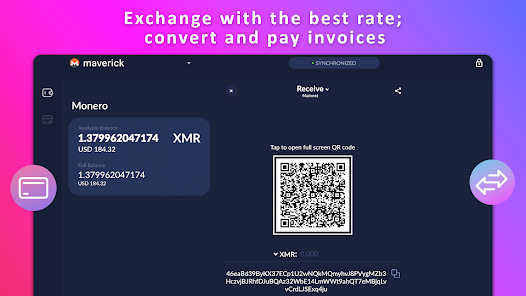
How in-wallet exchanges actually work (mechanics, not marketing)
At the protocol level, an in-wallet swap is an orchestration problem: your wallet must find a counterparty or market maker, route assets across potentially different chains, and settle on both sides while you control the private keys. There are three basic models: integrated custodial exchange (wallet signs you into an external service that holds funds), atomic-swap or peer-to-peer routing, and a routing layer that aggregates market makers without custody. The last is often the most privacy-amenable when implemented correctly because it can avoid holding funds centrally while still finding competitive pricing.
One practical implementation detail to watch for is whether the swap uses a decentralized routing service such as NEAR Intents-style automation. That method identifies paths across multiple market makers and relayers to produce a swap without requiring the wallet developer to custody funds. By decentralizing the routing decision, it reduces single-point metadata collection about who swapped what. But decentralization alone doesn’t guarantee privacy: routing nodes, relayers, or market makers may still learn trade-related metadata unless the wallet provides network-level protections.
Which components determine anonymity—and where they can leak data
Privacy is the composite of several layers. To reason clearly, treat them separately:
– Key custody and wallet architecture: Non-custodial control of private keys is necessary but not sufficient. If the wallet can sign locally and never sends private keys or view keys to servers, that’s strong. For Monero specifically, keeping the private view key local is a material privacy win because remote nodes cannot reconstruct your incoming transaction graph.
– Network-level anonymity: Even when keys stay local, IP addresses and network traffic patterns are revealing. Tor-only modes, I2P support, and custom node connections materially reduce linkage between your network identity and on-chain operations. If a swap path requires connecting to third-party nodes or APIs, a Tor-only option prevents those endpoints from trivially linking your IP to swap requests.
– Exchange routing and counterparty metadata: Decentralized routing (e.g., NEAR Intents) disperses market knowledge across multiple entities and reduces single-bucket logging risks. However, each market maker still sees the counterparty details for the leg it fills. The question becomes: do those market makers link requests to network identifiers? If yes, privacy erodes.
– Chain-level privacy properties: Different chains offer different guarantees. Monero’s ring signatures, stealth addresses, and confidential transactions make correlation far harder than on Bitcoin. BTC privacy tools like PayJoin or Silent Payments improve privacy but still operate on a transparent ledger. Litecoin MWEB adds an optional confidential layer, but activation and mixing patterns influence anonymity sets.
Case study: swapping BTC to XMR inside a privacy-first wallet
Imagine Alice in New York uses a multi-platform wallet that is open-source, non-custodial, supports Monero, Bitcoin, and Litecoin MWEB, includes Tor and I2P, and routes swaps via a decentralized intent system. Here’s how privacy unfolds across the key steps:
1) Initiation: Alice opens the wallet with device-level encryption and a biometric lock. The private keys and Monero private view key never leave the device. That bounds risk at the key control layer.
2) Network connection: She enables Tor-only mode. The request to find market makers and route an XMR offer leaves the device via Tor circuits, masking her IP from the market-makers and swap relayers that handle the trade.
3) Routing: The wallet uses NEAR Intents-like decentralized routing to locate a path from BTC to XMR. Multiple market makers participate; none gains a complete ledger of the end-to-end swap request. The decentralized approach reduces single-party observation risk but does not remove it entirely.
4) Settlement: For the BTC leg, the wallet can use PayJoin v2 or UTXO coin control. PayJoin obfuscates the origin of funds by creating a transaction that includes inputs from the receiver, making chain analysis harder. For the XMR leg, funds settle into subaddresses with stealth outputs; the private view key remaining local means remote nodes cannot scan and reconstruct incoming flows.
Net result: Alice achieves materially stronger privacy than if she had used a custodial exchange and a standard Bitcoin wallet, but not perfect anonymity. Each component reduced linkage: local keys prevented server-side custody; Tor masked network identity; decentralized routing distributed metadata. The remaining risk stems from the market makers themselves (who saw trade legs) and timing or chain-level correlation if on-chain patterns are distinctive.
Trade-offs and limitations you must accept
No wallet stack is a privacy panacea. Here are the key trade-offs you should weigh:
– Convenience vs. compartmentalization: In-wallet swaps are faster and avoid extra on-chain transfers, but doing every operation from one device/context concentrates metadata. If the wallet records nothing (no telemetry), that concentration is less dangerous, but external counterparties still observe swap-related traces.
– Decentralized routing vs. single-counterparty liquidity: Aggregated routing finds better rates but increases the number of entities that see partial swap data. Greater fragmentation can reduce the chance any one party links the entire flow, but it increases the surface for metadata leakage.
– Chain privacy differences: Moving from BTC (transparent ledger) to XMR (privacy-by-default) reduces long-term traceability for funds once they are in Monero, but history prior to the swap may still exist in on-chain records that forensic analysts can use to correlate timing or amounts. Using PayJoin and transaction batching on the BTC side mitigates but does not eliminate that correlation risk.
– Usability vs. extreme opsec: Hardware integrations like Ledger or air-gapped Cupcake devices materially increase key security and reduce attack vectors, but they can complicate routine swaps and require additional steps to maintain Tor and custom node configurations.
Decision-useful heuristics for U.S. privacy-conscious users
1) Prioritize local key control first. If the wallet is open-source and non-custodial, ensure the private view keys (Monero) and seed never leave your device. That blocks server-side scanning and is the strongest baseline.
2) Use network privacy for swaps that matter. Enable Tor-only or I2P when initiating cross-chain swaps, especially if you care about dissociating your IP from the transaction windows. In the U.S., where metadata can be subpoenaed, layering Tor reduces the easy legal pathways that link IP logs to user identity.
3) Combine chain-level tools deliberately. For BTC legs, prefer PayJoin, UTXO coin control, and batching. For LTC, enable MWEB when you want confidential amounts. For ZEC, rely on mandatory shielding flows when supported. Mixing primitives across chains provides overlapping protections.
4) Assume market makers see partial data. When you need maximal secrecy, consider breaking large swaps into smaller, time-staggered operations or using intermediate privacy-enhancing steps. This is a pragmatic mitigation, not a guarantee.
What to watch next (signals and conditional scenarios)
Signal: wider adoption of decentralized routing and Intents-style aggregators. If more wallets adopt intent-based routing, the liquidity landscape will deepen and the single-provider metadata risk will fall — provided wallets maintain strong network privacy defaults. Conversely, if routing consolidates around a few large relayers, privacy benefits diminish.
Signal: regulatory pressure on market makers. If U.S.-based or regulated market makers are required to log more metadata, swaps that route through them will leak more. That would increase the relative advantage of routing through non-logged, decentralized liquidity profiles reachable over privacy-preserving networks.
Scenario to watch: usability wins that lower privacy defaults. Wallets that prioritize “one-tap” swaps without clear network privacy options could normalize behavior that centralizes metadata. The practical defense is user education and wallets that ship with privacy-preserving defaults like Tor-only for swaps involving privacy-sensitive assets.
Practical next steps for readers
If you want a wallet that combines multi-coin convenience with strong privacy primitives, test these features before committing: non-custodial key handling; Tor/I2P and custom node configuration; PayJoin and UTXO controls for BTC; Monero subaddress and local view-key policies; integrated MWEB for LTC; and hardware wallet / air-gapped support for high-value storage. One practical reference point is the wallet project discussed here — you can learn more about its multi-currency, privacy-first approach at cake wallet.
FAQ
Does using an in-wallet swap mean the wallet developer can see my transactions?
Not necessarily. If the wallet is open-source, non-custodial, and enforces a zero-telemetry policy while keeping private keys local, the developer cannot see your private keys or raw transaction history. The remaining exposure is to the market makers and relayers involved in the swap; that’s why network-level privacy (Tor/I2P) and decentralized routing matter.
Is Monero always private if I receive funds through an in-wallet swap?
Monero provides strong on-chain privacy through stealth addresses and ring signatures, and keeping your view key local prevents remote scanning. But the moment of conversion (the swap) can leave metadata on the source chain (e.g., Bitcoin). Use PayJoin, coin-control, and Tor to reduce linkage, and consider staging or breaking swaps if you want to further reduce traceable patterns.
How does Litecoin MWEB help me, and are there caveats?
MWEB adds confidential transactions to Litecoin, hiding amounts and improving fungibility. It’s an optional layer, so whether you get privacy benefits depends on activation and the size of the anonymity set. Early or small usage can leak patterns; broader adoption improves protections. Also, MWEB privacy does not replace network-level protections.
Should I always use Tor/I2P with swaps?
For privacy-conscious users in the U.S., Tor or I2P significantly reduces network-level linkage and is recommended when performing swaps that you don’t want associated with your IP. The trade-off is slightly slower connectivity and occasional compatibility friction with certain relayers; nonetheless, the privacy benefits are substantial.





Stay Informed With the Latest & Most Important News
Previous Post
Next Post


Advertisement
